If you’ve ever stood at a starting line wondering what pace you should hold, you know the anxiety of race pacing. Will you start too fast and hit the wall, or start too slow and miss your goal?
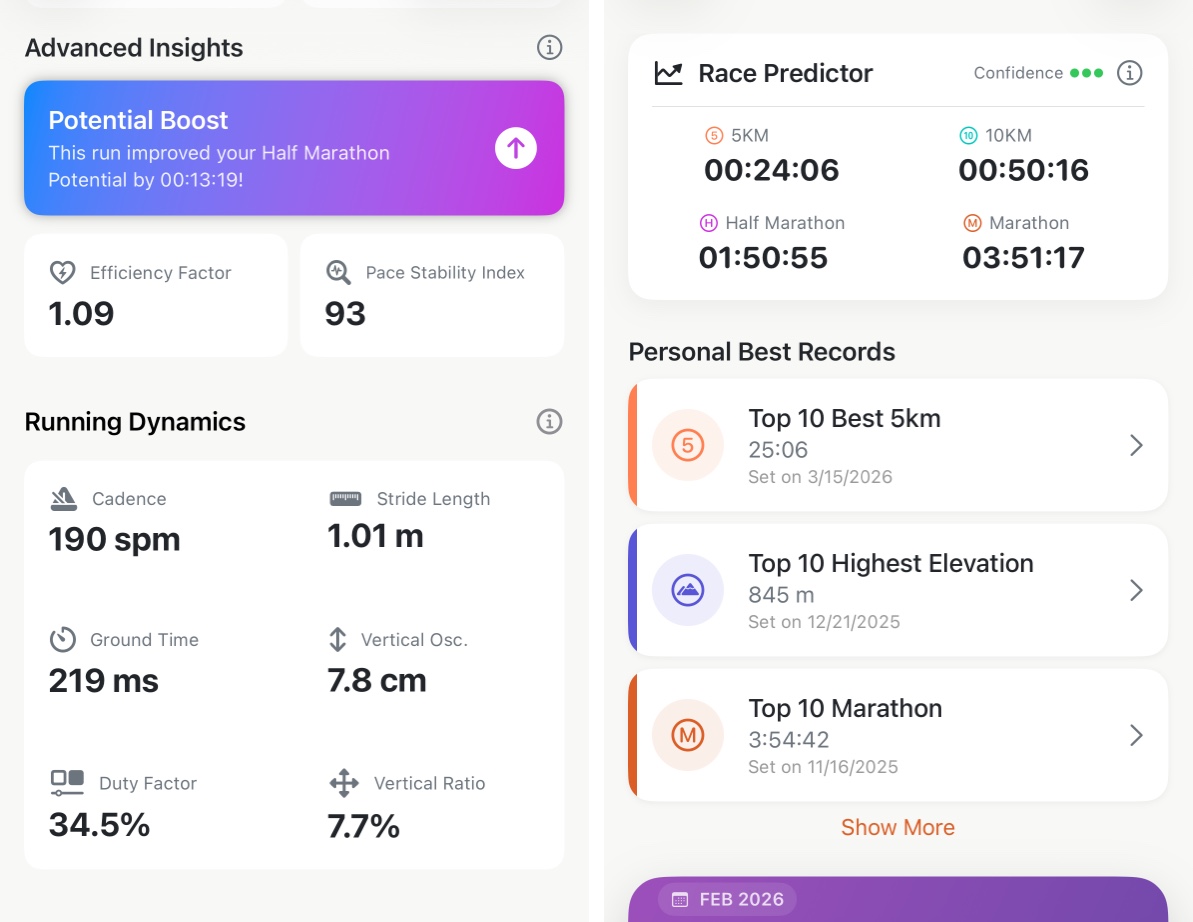
The Apex Run Race Predictor removes this guesswork entirely. By automatically analyzing your real-world running data, it forecasts your exact finish times for everything from a 5K to a full Marathon.
How Does it Work? Riegel’s Formula
At its core, the predictor is powered by Riegel’s Formula, a mathematically proven method developed by researcher Peter Riegel in 1977 to predict race times across different endurance distances.
The formula is elegantly simple:
T2 = T1 × (D2 / D1)^1.06
Where:
- T1 is your known time for a baseline run (e.g., your fastest recent 10K).
- D1 is the distance of that baseline run.
- D2 is the distance of your upcoming race (e.g., a Marathon).
- T2 is your predicted finish time for the new race.
The exponent 1.06 accounts for the natural fatigue curve—you mathematically lose a predictable amount of speed as a race gets longer.
The Magic: Using Your Last 6 Weeks
The biggest problem with manual pace calculators is choosing the right “baseline” run (T1). If you choose a personal best from a year ago when you were fitter, your marathon prediction will be dangerously fast. If you choose an easy jog, it will be far too slow.
Instead of asking you to input arbitrary PRs, Apex Run automatically scans your last 6 weeks of training. It mathematically identifies your most representative efforts—filtering out easy recovery jogs and interval rests—and naturally calibrates Riegel’s Formula to your exact, current fitness level.
Because your fitness changes constantly, your predicted finish times organically update every time you log a run.
Understanding Your Prediction
Why is the prediction sometimes slower than my all-time PB?
“PB represents your peak, prediction reflects your current state.”
Your fitness naturally fluctuates with your training loops—moving through Base, Peak, and Recovery cycles. Because Apex focuses on your most recent training performance, a prediction might appear slower than your all-time best if you are currently doing mostly easy runs or are in a recovery block.
This is completely normal! As you incorporate more high-intensity workouts and approach your peak phase, the prediction will trend back upwards to match your race-day readiness.
Check your Race Predictor in Apex Run today to see what you are currently capable of!